
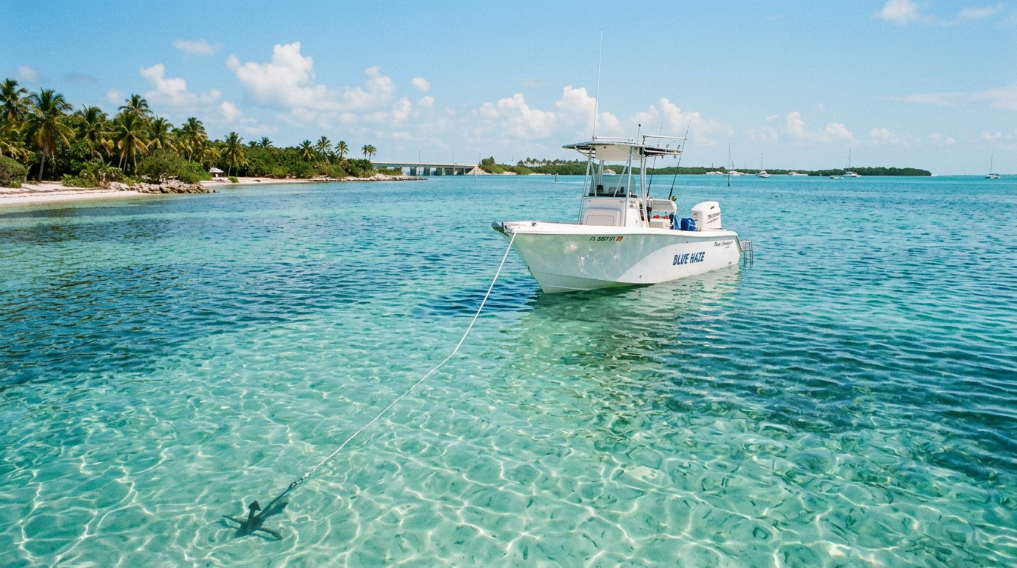
You drop anchor in a quiet Florida cove, settle in for lunch, and thirty minutes later you’re drifting toward somebody’s dock. It happens to boaters every weekend, and the cause is almost never the anchor itself. It’s the scope — the ratio of rope to water depth. Florida’s tides, shifting sand, and afternoon storms make proper scope more important here than in many other places, and the rope you use affects how well that scope works. A quality nylon boat anchor rope stretches and absorbs load in ways that make a correct scope setting genuinely hold. Here’s how to get it right
Thank you for reading this post, don't forget to subscribe!Quick Answer
Anchor scope is the ratio of anchor line length to water depth, and it matters because your anchor holds by pulling nearly horizontal along the bottom. For most Florida day anchoring, use 5:1 scope in calm conditions and 7:1 to 10:1 when wind or current picks up. Add the height of your bow above the water to your depth calculation, and account for Florida’s tidal range — a spot that’s 8 feet deep at low tide may be 11 feet at high tide.
Key Takeaways
- Scope is measured as line length divided by water depth, and the bow height above water must be added to that depth before calculating.
- Florida’s tides can change your effective depth by several feet, so set scope for the highest water you expect during your stay, not the depth when you drop anchor.
- Nylon is the standard anchor line material because its stretch absorbs shock loads from waves and boat surge; chain at the anchor end improves the horizontal pull that makes scope work.
- Too little scope is the most common anchoring mistake, but excessive scope in a crowded anchorage creates swing problems and can foul other boats.
- Sand and mud bottoms common around Florida hold well with proper scope; grass and rock require different technique entirely.
What Anchor Scope Actually Means
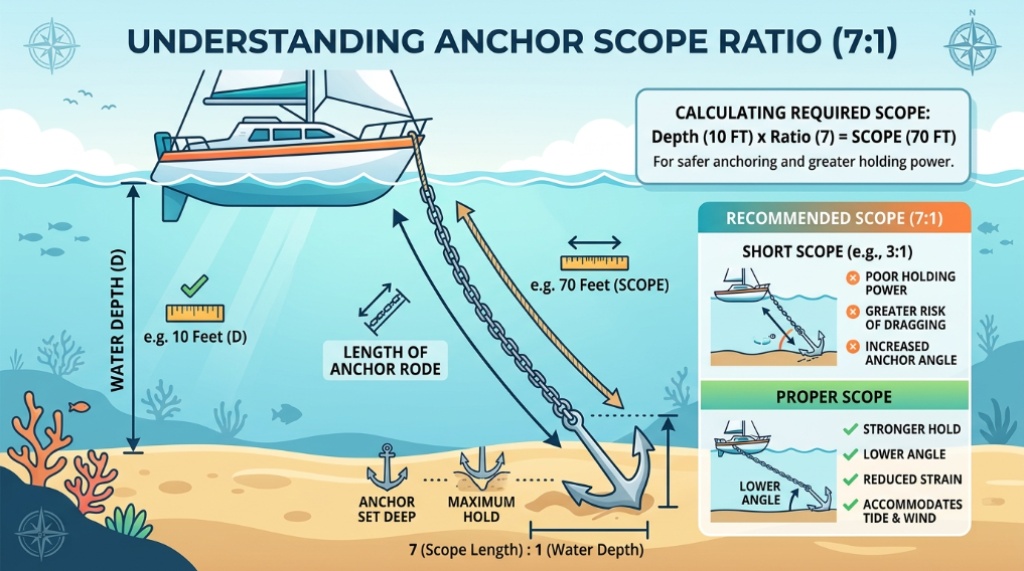
Scope is a simple ratio: the length of anchor line you deploy divided by the depth of the water from the bottom to your bow roller. If you’re in 10 feet of water with your bow 3 feet above the surface, your effective depth is 13 feet. At 5:1 scope, that means 65 feet of line. At 7:1, roughly 91 feet.
The reason scope exists is geometry. An anchor doesn’t hold by weight — it holds by digging in and resisting a pull that runs close to parallel with the seabed. If your line angles steeply down to the anchor, the pull is mostly upward, and the anchor can break free. More scope flattens that angle. Less scope steepens it. That’s the entire principle.
Why Bow Height Matters
Many boaters calculate scope using only the depth sounder reading. That’s a mistake. The anchor line runs from the anchor on the bottom to the bow roller, so the vertical distance includes the freeboard between the water surface and your bow. On a boat with 4 feet of freeboard in 8 feet of water, the actual vertical distance is 12 feet, not 8. Ignoring bow height means you deploy roughly a third less line than you intended.
Why Florida Specifically Changes the Math
Florida anchoring is not the same as anchoring in a deep, tideless lake. Three local factors make scope calculations more demanding.
Tidal Range
Florida’s tidal range varies dramatically by region. Parts of the Big Bend area and the Florida Panhandle can see several feet of swing between low and high tide, while some Florida Keys locations see less. The practical consequence: if you anchor at low tide and stay through high tide, the water gets deeper and your scope ratio drops. A 5:1 setup at low tide can become closer to 3.5:1 at high tide, which may not hold.
The fix is simple. Calculate scope using the highest predicted water level during your stay, which you can get from local tide tables. This is the single most overlooked step in Florida anchoring.
Afternoon Thunderstorms and Sea Breeze
Florida’s summer pattern — calm mornings, building sea breeze, afternoon storms — means conditions at 2 p.m. often look nothing like conditions at 10 a.m. When a squall line passes, wind can jump in minutes. A boat that was resting comfortably on 5:1 scope now surges hard against its line. More scope and a stretchy line give you margin.
Bottom Composition
Florida offers a wide mix of holding ground: soft sand, shell hash, mud, seagrass, and limestone hardbottom. Sand and mud generally hold well when scope is adequate. Seagrass can prevent an anchor from penetrating at all, and dragging an anchor through grass damages habitat, which is restricted in many Florida areas. Limestone hardbottom offers little for a plow or fluke anchor to bite into. In those conditions, scope alone won’t save you — you may need to relocate before heading out on the water, make sure you know your gear by checking out the guide does nylon rope float? discover right now
How Much Scope Should You Use?
The table below reflects conventional anchoring practice. Treat it as a starting point, not a rule cast in stone, and adjust for crowded anchorages, forecast weather, and bottom type.
| Condition | Typical Scope | When It Fits |
|---|---|---|
| Calm, light wind, settled weather | 5:1 | Lunch stops, protected coves, short stays |
| Moderate breeze or tidal current | 7:1 | Day anchoring, exposed bays, overnight in mild conditions |
| Strong wind, squalls, overnight in open water | 8:1 to 10:1 | Storm anchoring, overnight in less protected areas |
| Crowded anchorage | Reduce to minimum that holds | When swing room is limited; often better to relocate |
Some experienced cruisers use all-chain rode and can get away with shorter scope because chain’s weight keeps the pull low even at steeper angles. That approach requires a windlass and adds weight forward, which isn’t practical for most Florida day boats and center consoles.
Where Nylon Fits Into the Scope Equation
Scope and line material work together. Nylon stretches under load — typically in the range of 15 to 25 percent at working load, depending on the specific rope construction — and that stretch does two useful things. It absorbs the snatch loads when your boat surges against the anchor in waves, and it lets the boat move slightly without jerking the anchor loose.
This is why nylon is the standard for anchor rode. Polypropylene floats but has minimal stretch and degrades in UV, making it a poor choice for serious anchoring. Polyester has less stretch than nylon and is sometimes used in mixed rodes. For typical Florida anchoring, three-strand or eight-plait nylon is the practical default.
Chain and the Anchor End
Most anchoring setups include a length of chain between the anchor and the nylon line — commonly 6 to 20 feet depending on boat size and anchor type. The chain serves two purposes: it protects the nylon from chafe on the bottom, and its weight helps keep the initial section of rode lying along the seabed, preserving the low pull angle that scope is meant to create. A common rule of thumb is a chain length roughly equal to the boat’s length, though shorter works on small boats in benign conditions.
Check your chain-to-rope connection — usually a splice or a shackle — before every trip. A worn splice or a shackle with a loosened pin is a silent failure point.
Setting the Anchor Correctly at the Right Scope
Deploying the right amount of line is only half the job. The anchor has to be set, and setting requires that the anchor actually dig into the bottom rather than skip across it.
- Stop the boat, lower the anchor to the bottom, and let out line as the boat drifts back. Don’t throw the anchor.
- Once you’ve deployed roughly the target scope, secure the line and put the boat in idle reverse. Apply power gradually.
- Watch two fixed landmarks — a tree, a house, a piling — and confirm they stay in the same relative position. If they move together, you’re dragging.
- If the anchor doesn’t set after a couple of attempts, retrieve it, check for grass or debris fouling the flukes, and try a different spot. In seagrass or hardbottom, moving is usually better than fighting the bottom.
Once set, note your position with your GPS or chartplotter’s anchor alarm. Scope is correct only if the anchor holds; a well-calculated ratio with a dragging anchor is still a drifting boat.
Common Scope Mistakes Florida Boaters Make
- Calculating scope from the depth sounder only. Bow height must be included, and it can be a significant fraction of the total on smaller boats.
- Anchoring at the current tide level. Florida’s tidal swings can turn an adequate scope into an inadequate one within hours.
- Deploying 3:1 in a crowded spot because everyone else is. Short scope can work briefly in ideal conditions, but it fails fast when wind shifts or a wake rolls through.
- Ignoring swing radius. At 7:1 scope in 13 feet of effective depth, you have roughly 91 feet of line out and your boat can swing in a circle with a radius approaching that length. In a tight anchorage, that’s how boats collide.
- Using worn or stiff line. Nylon loses elasticity with age, UV exposure, and abrasion. A line that’s been sitting in the sun for years may not stretch when you need it most.
Balancing Scope Against Room to Swing
More scope means more swing. This is the central trade-off in any crowded Florida anchorage, whether it’s a popular sandbar, a restaurant dock area, or a mooring field approach.
If you can’t deploy adequate scope without swinging into another boat or a dock, the correct answer usually isn’t to compromise on scope — it’s to anchor somewhere else. An underscoped anchor in tight quarters creates two problems at once: it may drag, and it may swing into your neighbor even if it holds. If you must stay, consider a Bahamian moor (two anchors set in opposite directions) or a stern anchor to limit swing, but only if local rules and conditions permit and other boaters understand what you’re doing.
Also check local regulations before anchoring. Florida has specific rules in some areas, including restrictions related to seagrass protection and designated anchoring zones in certain municipalities. The Florida Fish and Wildlife Conservation Commission publishes current guidance.
Frequently Asked Questions
What is the ideal anchor scope for a day trip in Florida?
For calm conditions and short stays, 5:1 is generally adequate. If wind or current picks up, or if you plan to stay through a tide change, increase to 7:1 or more. Calculate using the deepest water you expect during your stay, plus bow height.
Does anchor rope stretch matter for scope?
Yes, indirectly. Nylon’s stretch absorbs surge loads so the anchor isn’t jerked loose, which means the scope you set actually stays effective in waves. A rope with little stretch transmits shock directly to the anchor, making even correct scope less reliable.
Can I use too much scope?
Yes. Excessive scope increases swing radius and can cause your boat to swing into others or into shallow water. In crowded anchorages, oversized scope is a hazard. Match scope to conditions and available room.
How do I account for tides when setting scope?
Check a local tide table for your location and add the difference between current depth and predicted high-water depth. Set scope based on that maximum figure. This is especially important in areas with large tidal ranges.
Is all-chain rode better than nylon for Florida anchoring?
All-chain allows shorter scope because chain weight keeps the pull angle low, but it’s heavy, requires a windlass, and is impractical for many small boats. Nylon with a chain leader is the standard and practical choice for most Florida recreational anchoring.
What should I do if my anchor drags even with proper scope?
First verify you’re actually at the scope you intended, including bow height and tide. If scope is correct and the anchor still drags, the bottom is likely the problem — grass, hardbottom, or loose shell. Retrieve, move, and try a different substrate.
Conclusion
Scope is what makes an anchor work, and in Florida it demands more attention than in tideless, sheltered waters. Calculate using water depth plus bow height, plan for tidal rise, and default to 7:1 when conditions are uncertain. Pair that discipline with a nylon rode that stretches and a chain leader that keeps the pull low, and your anchor will hold through the afternoon squall that catches everyone else off guard. The next step is simple: before your next trip, measure your typical anchoring depth, check the tide table for your favorite spot, and mark your rode so you can deploy the right length without guessing.