
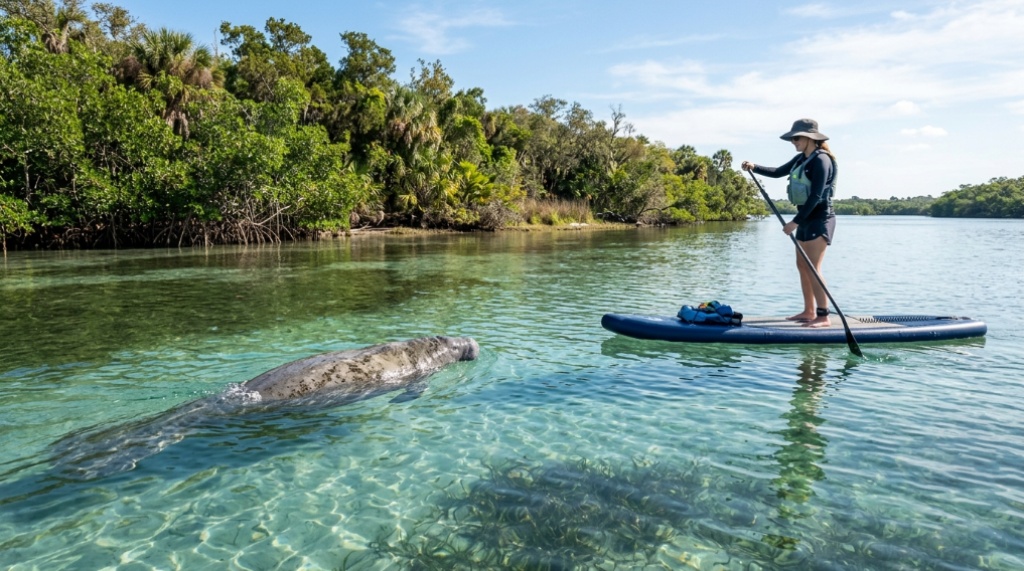
Florida’s springs and coastal waterways offer some of the most rewarding paddleboarding in the world, but they come with a responsibility that many newcomers don’t fully grasp until they’re already on the water. Manatees are protected by federal and state law, and a single careless paddle stroke or moment of curiosity can lead to serious legal consequences and harm to an animal that has no natural defense against a fast-moving board. Choosing the Best Inflatable SUP For Beginners is only part of the equation; understanding how to share the water with manatees, sea turtles, dolphins, and nesting birds matters just as much. This guide covers the etiquette, the rules, and the practical habits that separate a responsible paddler from a wildlife disturbance.
Thank you for reading this post, don't forget to subscribe!Quick Answer
Keep at least 50 feet between your paddleboard and any manatee, never chase, touch, feed, or block one from surfacing or reaching open water, and give them the right of way at all times. Manatees are protected under the Endangered Species Act and Florida’s Manatee Sanctuary Act, and harassment—intentional or not—can result in fines, legal penalties, and stress or injury to the animal.
Key Takeaways
- Maintain a minimum 50-foot buffer from manatees and never pursue one, even if it approaches you first.
- Stay out of designated Manatee Protection Zones and idle or paddle slowly in posted speed-limit areas.
- Manatees surface to breathe every few minutes, so give them clear vertical and horizontal space at all times.
- If a manatee approaches your board, stop paddling, keep your paddle out of the water, and let it pass on its own terms.
- Disturbing manatees, sea turtles, or nesting birds can result in federal and state penalties, regardless of intent.
Why Manatee Etiquette Matters More Than Most Paddlers Realize
Manatees are slow, curious, and largely defenseless. They have no natural predators in Florida waters and no instinct to flee quickly from a paddleboard. That combination makes them unusually vulnerable to human contact.
When a paddler chases a manatee for a photo, blocks it from surfacing, or tries to touch it, the animal often responds by diving and swimming away at speed. That may seem harmless, but repeated stress responses can push manatees out of warm-water refuges, disrupt feeding, and separate mothers from calves. In areas like Crystal River, Blue Spring, and the Indian River Lagoon, where manatees congregate seasonally, the cumulative effect of many well-meaning but uninformed paddlers is a real conservation problem.
Beyond ethics, there are legal stakes. Manatees are protected by the Marine Mammal Protection Act and the Endangered Species Act at the federal level, and by the Florida Manatee Sanctuary Act at the state level. Harassment is defined broadly, and “I didn’t know” is not a legal defense.
Core Manatee Etiquette Rules Every Paddler Should Follow
These are the practical rules that experienced Florida paddlers treat as non-negotiable.
Distance and approach
- Stay at least 50 feet away from any manatee. Some refuges and sanctuaries require more.
- Never approach a manatee directly, even if it seems to be approaching you. Let it close the gap.
- Do not pursue a manatee that swims away. Following it is considered harassment.
- Avoid positioning your board between a manatee and open water, its calf, or its escape route.
Contact and paddling behavior
- Do not touch, pet, scratch, or ride a manatee. This is illegal and can habituate the animal to humans.
- Never feed or offer water. It changes natural foraging behavior and can make manatees seek out boats and people.
- Lift your paddle out of the water if a manatee is nearby. A paddle strike can injure a manatee’s back or head.
- Stop paddling and stay still if a manatee surfaces next to your board. Sudden movement can startle it into a panic dive.
Photography without harassment
- Use a zoom lens rather than moving closer.
- Do not use a GoPro on a stick to push near a manatee.
- Do not surround a manatee with multiple paddlers, even if no one is touching it.
Where Florida’s Manatee Rules Apply
Manatee protections are not uniform across the state. Certain areas are designated as Manatee Protection Zones or Sanctuaries with stricter rules, seasonal closures, or speed limits.
| Area type | What it usually means for paddlers |
|---|---|
| Manatee Sanctuary | No entry, no anchoring, no paddling, or no water contact allowed. Often marked with buoys and signage. |
| Manatee Protection Zone | Speed and wake restrictions apply. Paddlers should move slowly and avoid disturbing resting manatees. |
| Seasonal warm-water refuges | Winter months often bring tighter restrictions in springs and power plant outflows. |
| Open coastal waters | Federal and state harassment laws still apply even without posted restrictions. |
Before launching, check local signage, Florida Fish and Wildlife Conservation Commission (FWC) notices, and any refuge-specific rules. In areas like Crystal River, Three Sisters Springs, and Blue Spring State Park, paddlers often need to be off the water or out of specific zones during cold snaps when manatees are concentrated.
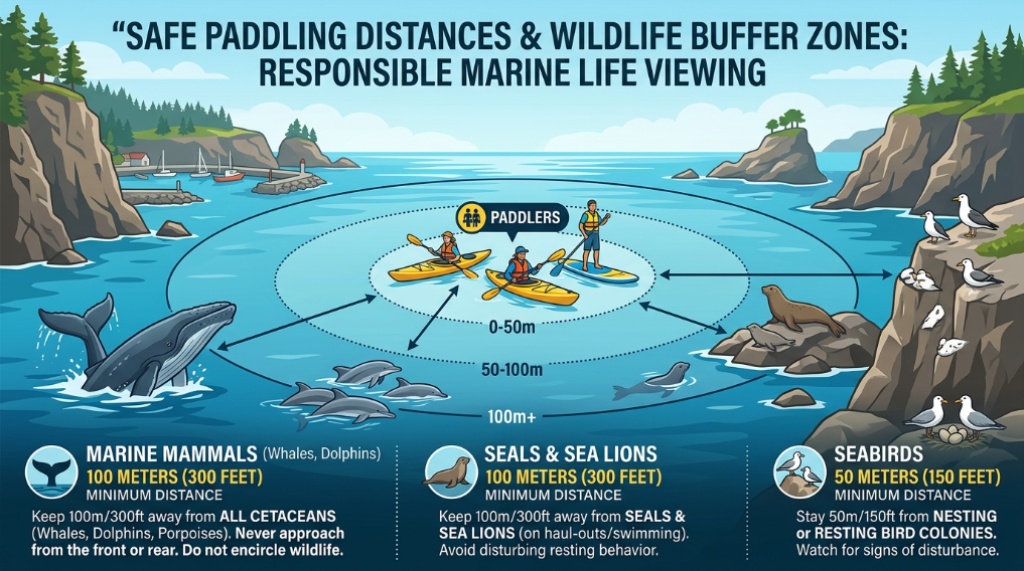
Wildlife Safety Beyond Manatees: What Else to Watch For
Manatees get most of the attention, but Florida paddleboarders share the water with several other species that require similar caution.
Sea turtles
Nesting season runs roughly from March through October. Keep distance, avoid paddling over seagrass beds where turtles feed, and never approach a turtle on the beach or in the water.
Dolphins
Dolphins are protected under the Marine Mammal Protection Act. Do not chase, feed, or attempt to swim with them, and give mothers with calves a wide berth.
Nesting shorebirds
Posting signs and roped-off dunes protect nesting areas. Landing your board near a nest can cause parents to abandon eggs or chicks.
Alligators
Alligators are common in Florida’s freshwater springs and rivers. Maintain distance, avoid swimming in murky water, and never feed one. Most alligator conflicts with paddlers stem from people cornering or provoking the animal.
Practical Setup: Gear Choices That Reduce Wildlife Risk
Your board and gear affect how close you can safely get to wildlife without causing harm.
- Darker board colors are less likely to spook manatees than bright white or neon finishes in clear spring water.
- Quiet paddling with a smooth stroke reduces noise and wake that can startle animals.
- A leash keeps your board attached, but in manatee-heavy areas use a quick-release waist leash or no leash at all so you are not dragged or tangled near an animal.
- A dry bag for your phone and ID keeps you from scrambling near the water if FWC or a refuge officer asks to see your gear or permit.
- Polarized sunglasses help you spot manatees and submerged obstacles before you are on top of them.
If you are still building your kit, an inflatable board with a stable, wide platform and a fin setup that tracks well in shallow grass flats makes it easier to hold a slow, controlled line near wildlife zones, For more techniques on water safety and board control, check out our guide on mastering the turtle roll technique for beginner surfers.
What to Do If a Manatee Approaches You
Manatees are naturally curious and sometimes swim directly toward paddleboards, especially in areas where they have been fed or habituated.
- Stop paddling immediately. Lift your paddle out of the water and rest it across your board.
- Stay still and quiet. Do not reach out, splash, or reposition to get a better look.
- Let the manatee pass. It will surface to breathe and move on if you give it space.
- Do not follow it after it moves away. Following is harassment.
- If it lingers, slowly and calmly back away using gentle strokes well away from the animal.
If a manatee is injured, entangled, or in distress, do not attempt to help it yourself. Contact the FWC Wildlife Alert Hotline at 888-404-3922.
Common Mistakes Beginner Paddleboarders Make Around Manatees
- Getting too close for a photo. A phone photo from 10 feet is not worth a federal violation.
- Blocking a manatee from surfacing. Manatees need to breathe frequently; a board directly over one is dangerous.
- Paddling into a sanctuary because it “looked open.” Buoys and signage are there for a reason.
- Assuming a manatee that approaches wants contact. Curiosity is not consent, and touching is illegal.
- Splashing or yelling to get a reaction. This stresses the animal and can trigger a sudden, dangerous movement.
- Ignoring seasonal closures. Winter restrictions protect manatees when they are most vulnerable.
Frequently Asked Questions
How close can you legally get to a manatee on a paddleboard in Florida?
Florida law and federal protections generally require you to stay at least 50 feet away from manatees. Some sanctuaries and refuges require more distance, and any approach that changes the animal’s behavior can be considered harassment regardless of distance.
What happens if you touch a manatee in Florida?
Touching a manatee is illegal under federal and state law. Penalties can include fines, civil penalties, and in serious cases criminal charges. Even unintentional contact while paddling can be treated as harassment.
Can you paddleboard in Crystal River with manatees?
Yes, but with strict rules. Certain areas like Three Sisters Springs are closed to paddlers during manatee season, and other zones require slow, no-wake travel. Always check current FWC and refuge rules before launching.
Do manatees ever attack paddleboarders?
Manatees are not aggressive and do not attack people. Injuries to paddlers typically happen when a manatee surfaces unexpectedly beneath a board, or when a paddler falls onto an animal while trying to interact with it.
What should I do if a manatee swims under my paddleboard?
Stay still, keep your paddle out of the water, and wait for the manatee to move on. Do not kick, splash, or try to push away. Manatees usually surface nearby and continue on their way if you remain calm.
Is it illegal to feed a manatee?
Yes. Feeding manatees is illegal and harmful. It teaches them to associate people and boats with food, which leads to dangerous interactions and can disrupt their natural foraging behavior.
Conclusion
Manatee etiquette is not about being overly cautious; it is about recognizing that Florida’s waterways are shared habitat. Keeping 50 feet of distance, never touching or feeding, giving manatees the right of way, and respecting sanctuary boundaries will keep you legal, keep wildlife safe, and make your paddle boarding experience far more rewarding. Before your next launch, check local rules, stay alert, and treat every manatee encounter as a privilege rather than a photo opportunity.